
A New Calendar for a New Era
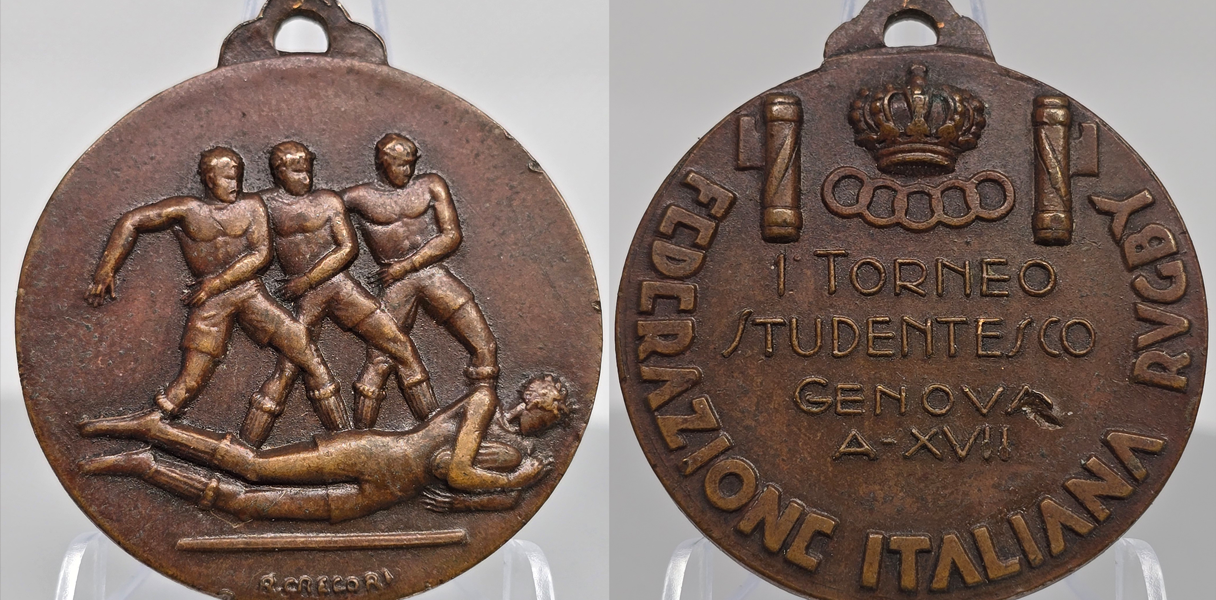
In 1930s Italy, Benito Mussolini’s regime sought to control every aspect of daily life, including the very concept of time. The government created a new calendar where Year I began in 1922, explicitly aligned with the Fascist March on Rome. Consequently, this fascinating bronze medal from a student rugby tournament in Genoa is dated Anno XVII—Year 17 of the Fascist era, which translates to 1938. It serves as a stark reminder of how deeply political ideology permeated even grassroots youth athletics.
Classical Roman Iconography
The physical design of this medal is a masterclass in state-sponsored political branding. Around the edges, one can clearly identify a royal crown, five Olympic-style rings, and the fasces—the bundled rods and axe that served as the primary symbol of Fascism. Furthermore, the sport is inscribed as “RVGBY,” substituting the ‘U’ with a ‘V’ to deliberately mimic the monumental style of ancient Roman inscriptions. For the regime, even the spelling of a foreign sport was an opportunity to manufacture a link to a glorious imperial past.
“Before heavily branding the sport as a tool for military readiness, the regime originally attempted to purge English influence entirely by officially renaming rugby to ‘palla ovale’ (oval ball).”
The Oval Ball and State Control
Despite these aggressive rebranding efforts, the traditional name of the game stubbornly survived among the players and the public. The presence of the word “RVGBY” on this very medal proves that even totalitarians had to compromise with the sport’s deeply rooted identity. However, while the original name persisted, the visual propaganda permanently infected the era’s sporting culture.
Rugby as a “Combat Sport”
The visual narrative on the obverse is highly unconventional for a sports medal, depicting three players striding forward together while one lies on the ground. To the modern observer, they look less like athletes and more like soldiers in formation marching past a fallen comrade. This militaristic imagery was entirely intentional; Achille Starace, head of the Italian Olympic Committee, explicitly promoted rugby as a “combat sport.” It was utilized in universities and youth groups to toughen young men, instilling strict discipline and a readiness for sacrifice.
A Legacy Intertwined with Conflict
Ultimately, this 1938 artifact transcends its original purpose as a mere tournament prize to become a powerful historical document. It perfectly illustrates how politics and military ambitions reached deeply into the world of the oval ball. Rugby has always maintained a close, complex relationship with the military, a bond that would only deepen in the ensuing years. In fact, many soldiers carried their love for the game straight into the battlefields of World War II, organizing matches between actual combat engagements.
«View this artifact in the Museum Catalog [link]»